Evidence Testing
Evidence testing is checking if information or proof supports an idea to see if it's likely true. 🤔
Introdução Breve
Evidence testing is like being a detective 🕵️♀️. When we have an idea or a theory, we need to see if there's any evidence to support it. It's used to determine if our beliefs are accurate and reliable, preventing us from making decisions based on incorrect information.
Explicação Principal
Gathering the Evidence 🔍
First, you need to collect all the available information related to your idea. This could involve doing research, conducting experiments, or making observations. For example, if you think that a certain type of fertilizer makes plants grow faster, you'd need to set up an experiment to test different fertilizers on different plants and record the results.
Analyzing the Evidence 📊
Once you have your evidence, you need to examine it carefully to see if it truly supports your idea. Are there patterns or trends that support your claim? Is the evidence reliable and unbiased? Using the fertilizer example, you'd need to analyze the growth data for each plant group to see if the plants with the special fertilizer consistently grew faster than those with other fertilizers or no fertilizer at all.
Considering Alternative Explanations 🤔
It's important to think about other possible reasons for the evidence you've found. Maybe something else caused the plants to grow faster, like more sunlight or more water. Ruling out these other explanations strengthens the case for your original idea. You might compare the amount of sunlight and water each plant received to check if those were factors.
Drawing Conclusions ✍️
After gathering, analyzing and considering alternatives, you can draw a conclusion about whether the evidence supports your idea. If the evidence consistently points to your idea being correct, you can say it is supported by the evidence. If the evidence is mixed or doesn't support your idea, you might need to revise your idea or look for more evidence. If the fertilizer consistently made plants grow faster, and other factors were ruled out, you could conclude that the fertilizer is effective.
Exemplos
- Imagine you're trying to figure out why your car won't start. You check the battery, the fuel gauge, and listen for any strange noises. Each check is a test, and the results (evidence) help you narrow down the problem. If the battery is dead, that's evidence the battery needs replacing. 🚗
- A doctor diagnosing an illness uses evidence testing. They ask about symptoms, run tests (like blood work), and consider your medical history. Each piece of information is evidence that helps them determine the correct diagnosis and treatment. 🩺
- In a courtroom, lawyers present evidence to support their case. Witnesses, documents, and forensic findings are all examples of evidence. The jury then evaluates this evidence to decide whether it proves the defendant's guilt or innocence. ⚖️
Domine Qualquer Matéria em 3 Passos Simples
- Escolha Seu Objetivo de Aprendizado: Selecione entre centenas de conceitos em ciências, negócios, humanidades e habilidades profissionais. Divida tópicos complexos em partes gerenciáveis.
- Aprenda Ensinando: Use nossa plataforma com IA para explicar conceitos como se estivesse ensinando outros. Descubra e preencha lacunas de conhecimento instantaneamente.
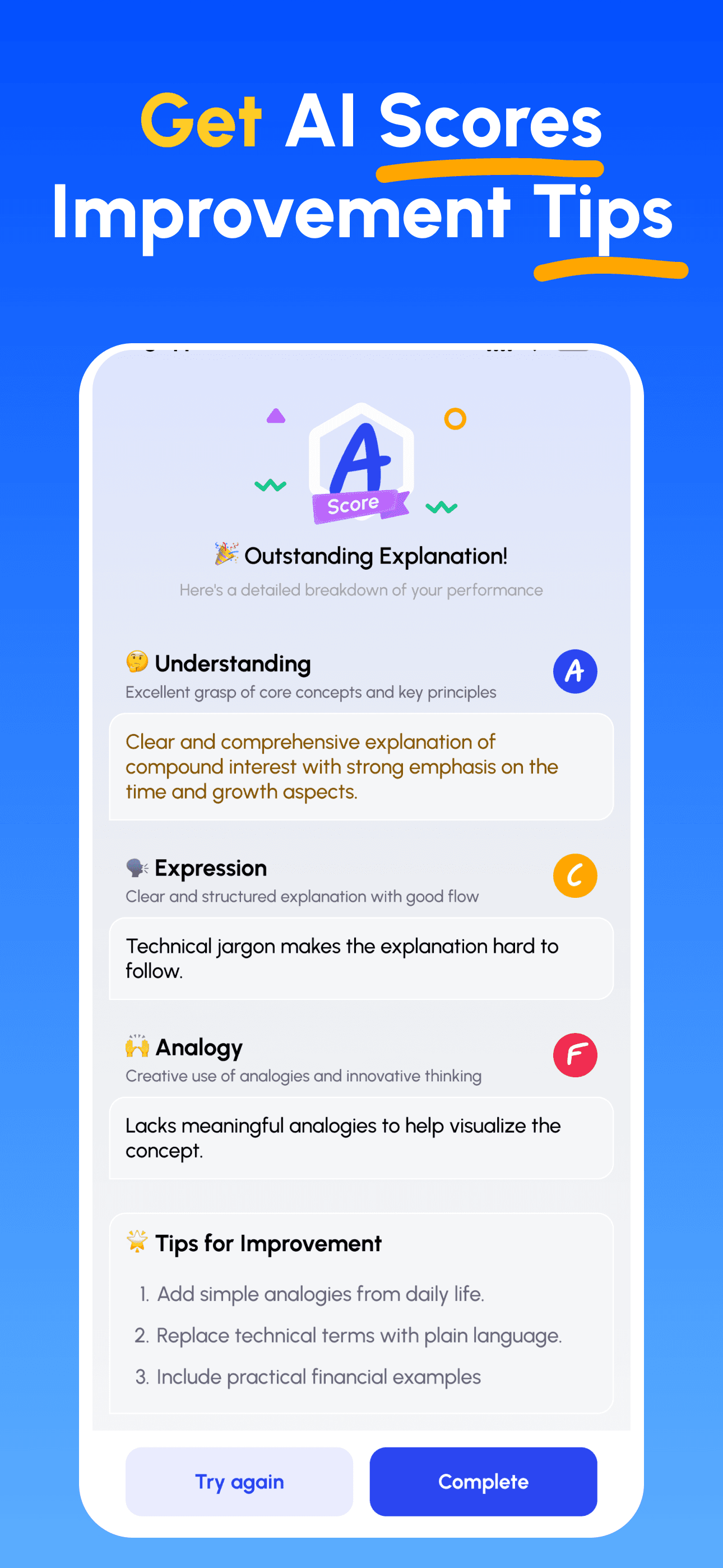
- Receba Orientação Especializada da IA: Obtenha feedback imediato e detalhado sobre sua compreensão, clareza de explicação e habilidades de aplicação prática.
- Revise pontuações e melhore: Siga dicas direcionadas, refine sua explicação e itere até poder ensiná‑la com simplicidade.
Baixe Feynman AI Agora
Comece sua jornada para uma melhor comunicação hoje!