Probability Theory
Probability theory helps us understand and predict how likely things are to happen in situations with uncertainty. 📊
Introduction Brève
Imagine you're trying to guess if it will rain tomorrow or if you'll win a game of cards. Probability theory gives us tools to make smart guesses about uncertain events, just like weather forecasters use it to tell us the chance of rain. It's the mathematical way of dealing with uncertainty, helping us make better decisions in everything from games to business. 🎲
Explication Principale
Basic Probability Rules 📐
Probability is measured from 0 (impossible) to 1 (certain). It's like a scale where 0 means something will never happen (like finding a real unicorn), and 1 means it's guaranteed (like the sun rising tomorrow). A 50% chance (0.5) is like flipping a coin - equally likely to happen or not happen.
Independent vs Dependent Events 🔄
Some events don't affect each other (like flipping a coin twice), while others do (like drawing cards without replacing them). It's like picking marbles from a bag - if you put each marble back after picking it, each pick is independent; if you don't, they're dependent because the number of marbles changes.
Probability Distributions 📈
This shows all possible outcomes and their chances. It's like having a recipe book where each recipe has a different chance of being chosen for dinner. Some might be favorites (high probability), while others are rarely picked (low probability).
Expected Value ⭐
This tells us what to expect on average over many tries. It's like knowing that if you play a game 1000 times, roughly how many times you might win. For example, if a game has a 30% win rate, you'd expect about 300 wins in 1000 games.
Exemples
- Weather Forecasting: When meteorologists say there's a 70% chance of rain, they're using probability theory based on historical data and current conditions. 🌧️
- Board Games: Rolling dice in Monopoly involves probability - the chance of rolling a specific number helps you plan your moves. For example, rolling a 7 with two dice has the highest probability (6/36). 🎲
- Insurance Companies: They use probability theory to set insurance rates by calculating how likely it is that someone will have an accident or need medical care based on various factors like age and history. 📋
Maîtrisez Toute Matière en 3 Étapes Simples
- Choisissez Votre Objectif d'Apprentissage: Sélectionnez parmi des centaines de concepts en sciences, commerce, lettres et compétences professionnelles. Décomposez des sujets complexes en parties gérables.
- Apprenez en Enseignant: Utilisez notre plateforme alimentée par l'IA pour expliquer des concepts comme si vous enseigniez à d'autres. Découvrez et comblez instantanément vos lacunes.
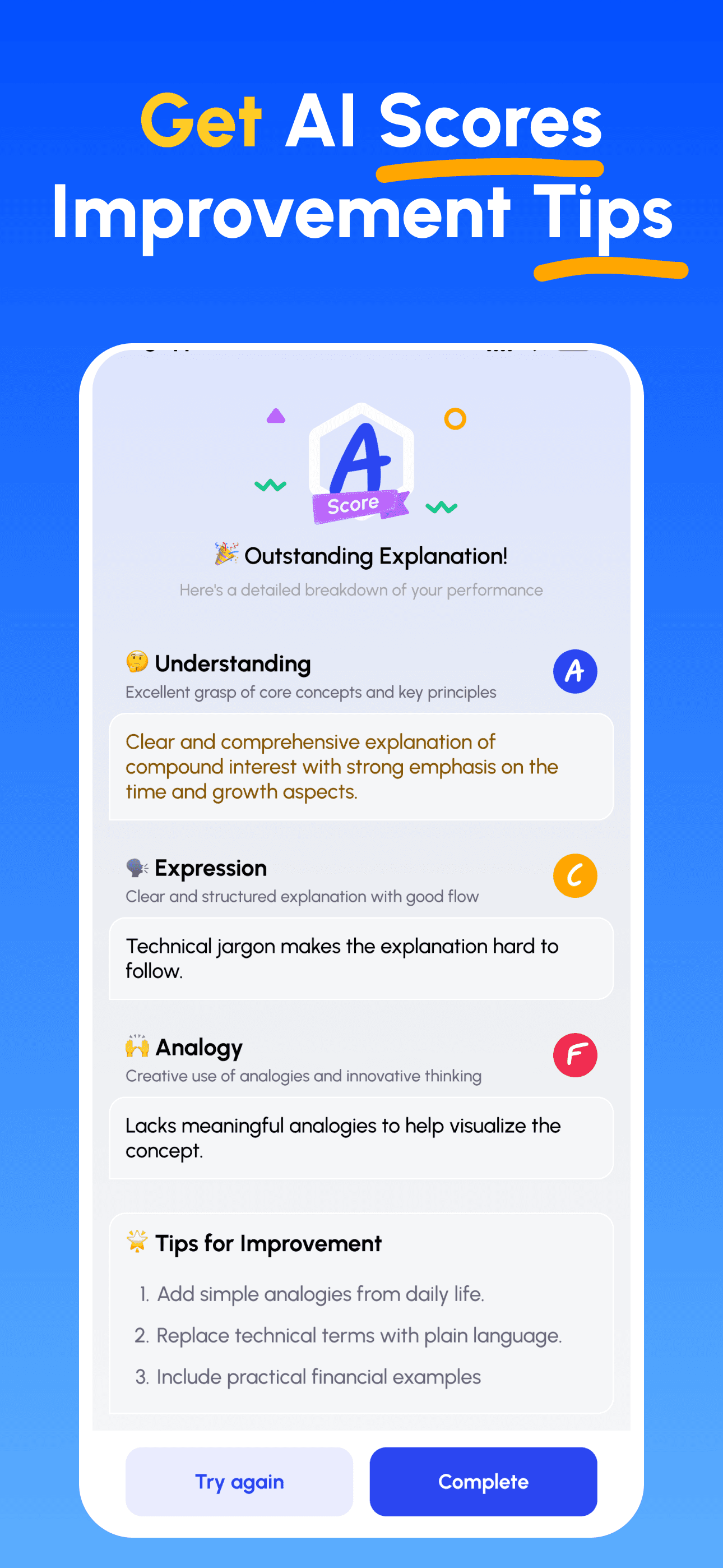
- Recevez des Conseils d'Expert par IA: Obtenez des retours immédiats et détaillés sur votre compréhension, la clarté de vos explications et vos compétences d'application pratique.
- Revoir les scores & améliorer: Suivez des conseils ciblés, affinez votre explication et itérez jusqu’à pouvoir l’enseigner simplement.
Téléchargez Feynman AI maintenant
Commencez votre parcours vers une meilleure communication dès aujourd'hui !